


Exercise is an accessible tool with significant potential for improvements in health and low side effects. Like the physiology of pain itself, the impact of exercise is systemic, affecting many physiological processes.
Exercise for pain relief
Exercise can have a direct pain relief effect.
Aerobic exercise of higher intensity (heart rate above 75% of max HR) triggers the release of endorphins, sometimes referred to as “happy chemicals.” They are our natural pain killers. In fact, they share their cell receptor with the strong and infamous opioid pain medications.
Fun fact! Laughing with friends and family can also trigger the release of endorphins.
Other biochemicals released with exercise that can block “potential-pain messages” include dopamine, serotonin and adrenaline.
Exercise also provides varying sensory experiences which can modulate pain reactions.
Exercise re-wires pain pathways
Chronic pain often arises from re-wiring of the nervous system including the brain, spinal cord and nerves leading to an overactive pain response. This increased activity in the nervous system results in pain being felt during activities and movements that would not normally provoke pain. Exercise, especially paired with certain Cognitive Behavioural Therapy (CBT) strategies and graded exposure, can help re-wire these pathways back to a less sensitive state.
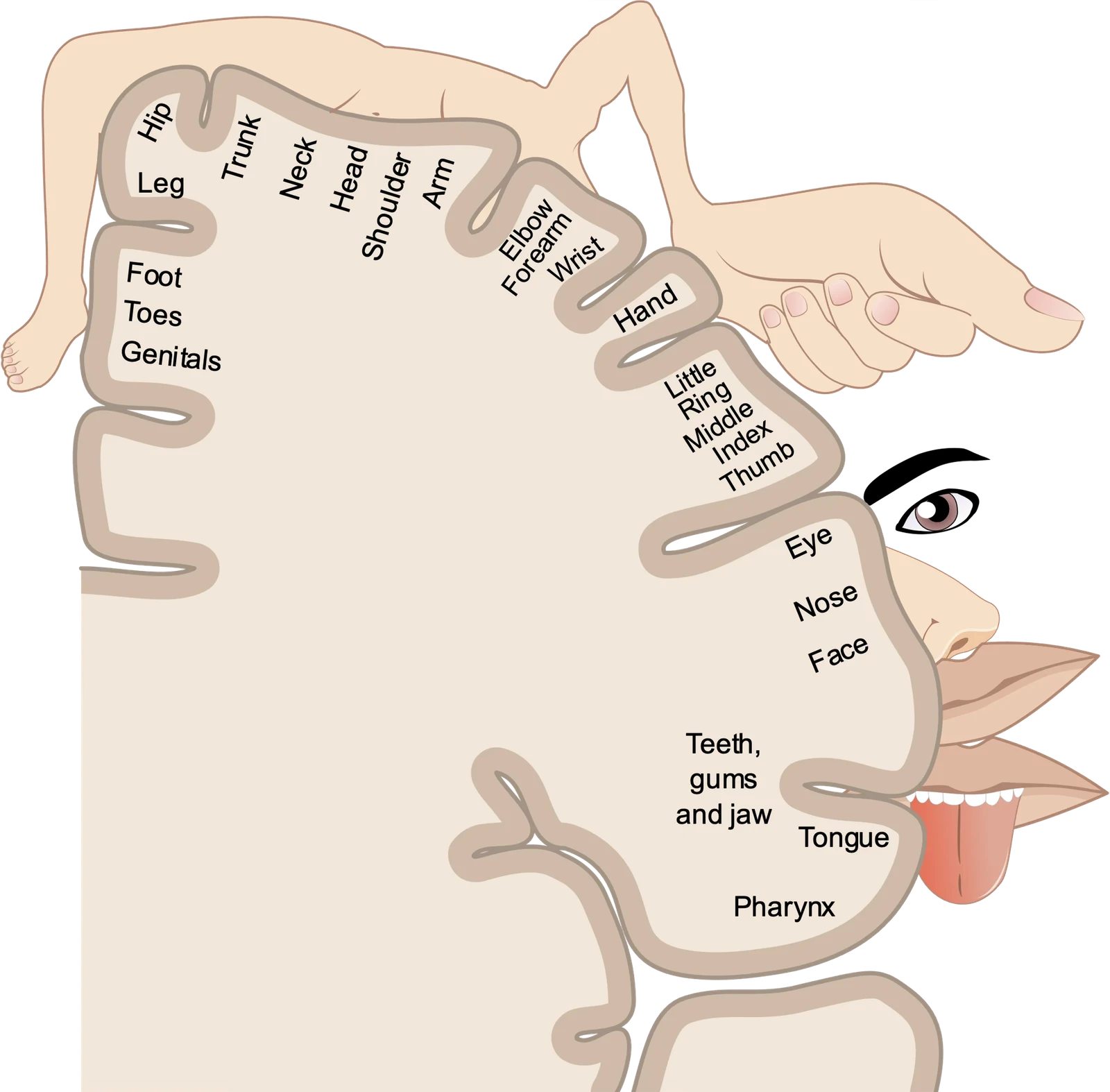
Another way the brain re-wires in response to pain is “smudging.” This is when the brain loses precision in identifying a specific painful body part causing the pain sensation to spread. The homunculus represents our somatosensory cortex. It is a simplified “map” of the sensory areas of the brain (see Figure 1 below). In chronic pain, the nerves that correspond to the painful body part in the homunculus begin to overcommunicate with their neighbours. As a result, the neighbours’ corresponding body parts also begin to feel painful.
Exercise focused on improving mobility and unlearning protective movement patterns can assist in re-organising this co-ordination and communication within the homunculus. By gradually retraining the body to move more freely and confidently, exercise can reduce the overcommunication between neighbouring sensory areas in the brain, helping to decrease the spread of pain.
Exercise increases physical tolerances
Exercise promotes physical adaptations such as strength, mobility and endurance which improves tolerance and capacity for activity and various postures.
Exercise improves beliefs and confidence
Practising exercise, especially when combined with helpful cognitive strategies, can improve confidence in the safety of engaging in normal activity.
Exercise improves health
Pain can negatively impact lifestyle factors such as sleep quality, stress levels and chronic inflammation. At the same time, these factors can, in turn, exacerbate pain and worsen health. Fortunately, exercise can help break this cycle by improving sleep, reducing stress, and decreasing inflammation, leading to a reduction in pain and improved quality of life.
- Brumagne, S., Diers, M., Danneels, L., Moseley, G. L., & Hodges, P. W. (2019). Neuroplasticity of Sensorimotor Control in Low Back Pain. Journal of Orthopaedic & Sports Physical Therapy, 49(6), 402–414. https://doi.org/10.2519/jospt.2019.8489
- Büntjen, L., Hopf, J.-M., Merkel, C., Voges, J., Knape, S., Heinze, H.-J., & Schoenfeld, M. A. (2017). Somatosensory Misrepresentation Associated with Chronic Pain: Spatiotemporal Correlates of Sensory Perception in a Patient following a Complex Regional Pain Syndrome Spread. Frontiers in Neurology, 8. https://doi.org/10.3389/fneur.2017.00142
- Da Silva Santos, R., & Galdino, G. (2018). Endogenous systems involved in exercise-induced analgesia. Journal of Physiology and Pharmacology: An Official Journal of the Polish Physiological Society, 69(1), 3–13. https://doi.org/10.26402/jpp.2018.1.01
- Hannibal, K. E., & Bishop, M. D. (2014). Chronic Stress, Cortisol Dysfunction, and Pain: A Psychoneuroendocrine Rationale for Stress Management in Pain Rehabilitation. Physical Therapy, 94(12), 1816–1825. https://doi.org/10.2522/ptj.20130597
- Kerage, D., Sloan, E. K., Mattarollo, S. R., & McCombe, P. A. (2019). Interaction of neurotransmitters and neurochemicals with lymphocytes. Journal of Neuroimmunology, 332, 99–111. https://doi.org/10.1016/j.jneuroim.2019.04.006
- Nijs, J., Mairesse, O., Neu, D., Leysen, L., Danneels, L., Cagnie, B., Meeus, M., Moens, M., Ickmans, K., & Goubert, D. (2018). Sleep Disturbances in Chronic Pain: Neurobiology, Assessment, and Treatment in Physical Therapist Practice. Physical Therapy, 98(5), 325–335. https://doi.org/10.1093/ptj/pzy020
- Suzuki, K. (2019). Chronic Inflammation as an Immunological Abnormality and Effectiveness of Exercise. Biomolecules, 9(6). https://doi.org/10.3390/biom9060223
- Wang, M.-J., Jing, X.-Y., Wang, Y.-Z., Yang, B.-R., Lu, Q., Hu, H., & Kang, L. (2023). Exercise, Spinal Microglia and Neuropathic Pain: Potential Molecular Mechanisms. Neurochemical Research. https://doi.org/10.1007/s11064-023-04025-4